
Understanding female fertility
A comprehensive UK guide to conception, age, ovulation, ovarian reserve, pelvic ultrasound, fertility blood tests, tubal assessment, male-factor testing and treatment pathways.

In this guide
What do fertility and infertility mean?
Fertility is the biological capacity to achieve a pregnancy and live birth. Infertility is defined by the World Health Organization as failure to achieve pregnancy after 12 months or more of regular unprotected sexual intercourse, although UK referral and treatment pathways vary by age, history and local commissioning arrangements.1
How conception happens
Several steps must align
- An egg develops and is released.
- Sperm travel through the cervix and uterus.
- At least one fallopian tube allows egg and sperm to meet.
- Fertilisation usually occurs in the tube.
- The embryo travels to the uterus and implants.
- Early pregnancy continues through complex hormonal and developmental stages.
No single screening test examines every step. A structured assessment may require ultrasound, hormone tests, semen analysis, tubal-patency testing and specialist review.
A “day 14” ovulation model applies only to some 28-day cycles.
Age, egg quantity and egg quality
Female age is one of the most important determinants of reproductive potential. Egg number declines over time, and the proportion of eggs with chromosomal abnormalities increases with age.
2024 UK IVF birth rate per embryo transferred
HFEA preliminary UK data, reported per embryo transferred; this is not the same as chance per treatment cycle or natural conception.3
Age and testing are not interchangeable
AMH and antral follicle count estimate ovarian reserve and can help predict response to ovarian stimulation, but they do not measure egg quality.
Common causes and contributors
Ovulation disorders
PCOS, thyroid disease, raised prolactin, weight change, hypothalamic dysfunction or premature ovarian insufficiency.5
Tubal factors
Damage or blockage after pelvic inflammatory disease, infection, endometriosis or pelvic surgery.1
Uterine factors
Fibroids, polyps, congenital anomalies or adhesions may affect implantation in selected cases.
Endometriosis
May affect ovaries, tubes, pelvic anatomy and inflammation. Normal ultrasound does not exclude superficial disease.
Age-related decline
Egg number and chromosomal competence decline with age.
Male factor
Low concentration, impaired motility, abnormal morphology, obstruction or hormonal causes.1
General health
Diabetes, thyroid disease, obesity, undernutrition, chronic illness and selected medicines.
Lifestyle and exposure
Smoking, alcohol, recreational drugs, heat exposure, anabolic steroids and toxins.
Unexplained infertility
In around one-quarter of couples, standard tests do not identify a clear cause.5
Do not delay when time may matter
NHS advice
See a GP after one year of regular unprotected sex without conception. Seek advice sooner if the female partner is 36 or over, there has been cancer treatment, possible STI exposure or another fertility concern.4
NICE advises intercourse every 2–3 days to optimise the chance of pregnancy.6
Consider earlier review for
- Absent or very irregular periods
- Previous ectopic pregnancy or PID
- Known endometriosis, fibroids or ovarian surgery
- Recurrent miscarriage
- Previous chemotherapy or pelvic radiotherapy
- Known sperm or testicular problems
- Severe pelvic pain
- Fertility-preservation concerns
What a proper fertility assessment may include
What fertility pelvic ultrasound can assess
High-resolution pelvic assessment
- Uterine size, shape and orientation
- Endometrial appearance and thickness
- Fibroids and cavity distortion
- Ovarian size, morphology, cysts and endometriomas
- Antral follicle count where appropriate
- Features suggesting adenomyosis or deep endometriosis
- Adnexal masses, hydrosalpinx or free fluid
What ultrasound does well
It gives real-time anatomical information without ionising radiation and may identify structural findings relevant to fertility planning.
What it cannot confirm
It cannot measure egg quality, guarantee ovulation, prove natural-conception potential, exclude all endometriosis or reliably confirm both tubes are open without a dedicated contrast study.
Fertility blood tests: what they can and cannot tell you
| Test | What it may assess | Important limitation |
|---|---|---|
| AMH | Ovarian reserve and likely response to stimulation | Does not predict spontaneous pregnancy or directly measure egg quality.2 |
| FSH | Ovarian or pituitary function in context | NICE advises not using FSH to predict ovarian response or assisted-conception outcome.2 |
| LH | Ovulatory or endocrine patterns | Strongly influenced by cycle timing. |
| Oestradiol | Follicular activity | Varies substantially across the cycle. |
| Progesterone | Evidence of ovulation when correctly timed | Should be timed to the cycle, not automatically called “day 21”.4 |
| Prolactin | Hyperprolactinaemia in selected patients | Affected by stress, medicines and sampling conditions. |
| TSH / thyroid | Thyroid dysfunction affecting cycles or pregnancy | Requires clinical interpretation. |
| Androgens / SHBG | Hyperandrogenism or PCOS assessment | PCOS is not diagnosed from one blood result or scan alone. |
Male fertility should be assessed early
Semen analysis commonly assesses
- Volume
- Concentration and total count
- Progressive and total motility
- Morphology
- Other laboratory findings
Why repeat testing may be needed
Semen parameters vary and can be affected by fever, illness, abstinence interval, collection issues, heat, medication and lifestyle. Abnormal results may require repeat sampling or specialist review.
The NHS lists semen analysis as a core test and advises assessment of both partners where applicable.4
Possible fertility treatment pathways
Optimised natural conception
Cycle understanding, intercourse every 2–3 days and management of health factors.
Ovulation induction
Medication to induce or regulate ovulation in selected conditions.
IUI
Prepared sperm is introduced into the uterus in selected situations.
IVF
Ovarian stimulation, egg collection, fertilisation, embryo culture and transfer.
ICSI
A single sperm is injected into an egg, often for significant male-factor infertility.
Fertility preservation
Egg, sperm or embryo freezing may be considered. Egg freezing is not a guarantee; age at freezing is important.7
Around 53,000 patients had IVF in the UK in 2024, with an average birth rate of 30% per embryo transferred; outcomes varied substantially by age and other factors.3
Choose the assessment level that matches your needs
UKSONO Healthcare performs the pelvic ultrasound and coordinates the pathway. Blood testing and online GP consultation, where included, are provided through trusted clinical partners.
Fertility Check
Pelvic ultrasound plus a Female Hormone Test covering 11 biomarkers.
- Pelvic ultrasound
- 11 biomarkers
- Structural and hormonal insight
Fertility Check Premium
Pelvic ultrasound, 10-biomarker Fertility Insight Blood Test including AMH, plus a 15-minute online GP consultation.
- Pelvic ultrasound
- AMH included
- 10 biomarkers
- Online GP review
Fertility Check Super Premium
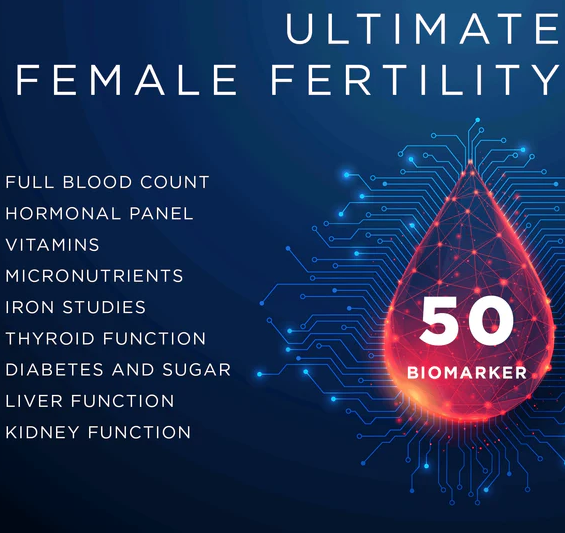
Pelvic ultrasound, 50-biomarker Ultimate Female Fertility Blood Test and a 15-minute online GP consultation.
- Pelvic ultrasound
- AMH and hormones
- Blood count, vitamins and iron
- Thyroid, glucose, liver and kidney markers
- Online GP review
Frequently asked questions
Can a normal fertility ultrasound confirm that I am fertile?
No. A scan assesses visible anatomy, but fertility also depends on age, ovulation, egg quality, sperm, tubal patency and implantation.
Is AMH an egg-quality test?
No. AMH is principally an ovarian-reserve and ovarian-response marker. It does not directly measure egg quality or predict spontaneous pregnancy.2
When is the best time for a fertility scan?
Timing depends on the question. Early-cycle scanning may support antral follicle count and baseline assessment; other questions may require different timing.
Does ultrasound show whether my tubes are open?
Routine pelvic ultrasound does not reliably confirm tubal patency. HyCoSy, HSG or laparoscopy may be required.
Do I need a GP referral?
No. UKSONO fertility checks can be self-booked. Abnormal findings may require GP, gynaecology or fertility-specialist follow-up.
Should my partner be assessed?
Yes, where applicable. Fertility problems may affect either or both partners, and semen analysis is a core part of complete assessment.4
Book your Women’s Fertility Check
Private pelvic ultrasound with blood-test and online GP-review options, coordinated by UKSONO Healthcare.
Website: www.uksono.com
Telephone: 01892 251532
References and clinical sources
- World Health Organization. Infertility fact sheet. Updated 28 November 2025.
- NICE NG257. Fertility problems: assessment and treatment—investigation and ovarian reserve testing. 31 March 2026.
- HFEA. Fertility treatment 2024: trends and figures. Published 16 June 2026.
- NHS. Diagnosis of infertility.
- NHS. Causes of infertility.
- NICE NG257. Initial advice to people concerned about delays in conception.
- HFEA. Egg freezing: a factsheet. Updated 31 July 2025.
- ESHRE. Evidence-based guideline: unexplained infertility. 2023.
- WHO. Polycystic ovary syndrome fact sheet. 2026.
- WHO. Endometriosis fact sheet. 2025.
Medical disclaimer: This article is educational and does not replace personalised medical advice, diagnosis or treatment. Fertility screening cannot guarantee conception or exclude every cause of infertility. Severe pelvic pain, collapse, heavy bleeding or possible ectopic-pregnancy symptoms require prompt medical assessment.
Clinical content reviewed and updated: 2 August 2026. HFEA 2024 outcome data are preliminary where stated by the regulator.